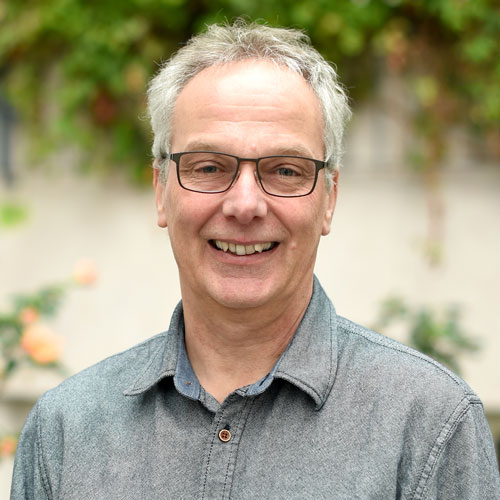
“Host and Showcase”
The 2027 Eco Field Days will take place at the Bauckhof in Amelinghausen, about 60 kilometers south of Hamburg. The Bauck Group also includes the Bauckhof Klein-Süstedt and Bauckhof Stütensen, as well as the Bauck Mill, which processes approximately 50,000 metric tons of organic grain annually. All four operations are co-organizers of the Organic Field Days. We spoke with Ralf Weber, farm manager at the Bauckhof Amelinghausen, and Friedemann Wecker, managing director of the Bauck Mill, about what the event means to them and how they view current trends in organic farming.
What was your first thought when it became clear that the Eco Field Days were coming to us?
Ralf Weber: It was definitely a mix of pride and respect for the task at hand. An additional incentive was the opportunity to be the first Demeter farm to host this fantastic industry gathering. When our association representative asked me if I could imagine applying, I immediately had a complete picture in my mind. For me, it’s definitely a unique opportunity to show visitors the diversity of the Bauck farms and the Bauck Mill, and at the same time, I was certain that I wouldn’t be facing this task alone.
Friedemann Wecker: My first thought was: This is both recognition and responsibility. The fact that the Eco-Field Days are taking place for the first time on a Demeter farm—and right on our doorstep, so to speak, at the Bauckhof Amelinghausen—brings the debate to where it belongs: to the farm, into the soil, and into practice. For farmers and people in the agricultural and food industries, this is an invitation not just to talk about organic farming and Demeter, but to take a look at concrete processes: How do we work? How do agriculture, animal husbandry, cheese-making, crop farming, social responsibility, and processing all fit together? Amelinghausen serves as both host and showcase. Together with the Bauck farms in Klein Süstedt and Stütensen, as well as the Bauck Mill, we want to demonstrate how a shared vision of value creation emerges from various independent sectors—from raw materials to the food on the shelf.
Farming and processing go hand in hand. The Bauck farms and Bauck Mühle are prime examples of this. What, in your opinion, makes for successful regional organic value creation?
RW: As a farmer, I’m first and foremost a producer at heart. I enjoy the smell of farmland, tilling the fields, and—ideally—reaping successful harvests. For this to work, I rely on stable value chains. It’s important to me that we meet regularly as equals and establish binding agreements. A fair discussion about prices and costs is essential in this regard. At the Bauckhof in Amelinghausen, we’re part of strong, long-standing value chains for chicken, potatoes, grains, and vegetables used for juice. Milk is the only product where we’re both the producer and the processor.
FW: For me, regional organic value creation is more than just keeping the distance as short as possible. It begins in the field, but it is only truly successful when the demands of agriculture, the possibilities of processing, and the expectations of retailers and consumers all align. This becomes clear when we ask specific questions: What quality must a raw material have for the mill? How is it processed? What products can be made from it that are both economically viable and delicious? At Bauck, we see this in a unique way: Three farms operate independently, each with different roles, yet remain ideologically connected through shared values, research, and the Agricultural Research Society. The Bauck Mill then translates this agricultural foundation into products that reach people in their everyday lives. Of course, not every raw material can come from the immediate region. What matters most, therefore, are openness, quality, and the question of where responsibility and value creation actually lie. Ultimately, a product must taste good, work well in everyday life, and offer reliable prospects for both producers and processors. For me, regional value creation is successful when a raw material gives rise not only to a product but also to a vision for the future of agriculture.
What developments in the organic food industry are particularly encouraging to you right now—and where do you think more progress is needed?
RW: It’s particularly encouraging that the organic market continues to grow. Organic food has become mainstream, and there are organic products in stores that I couldn’t have imagined 15 years ago. It’s also encouraging that people are interested. Here in Amelinghausen, we get so many requests for tours that we can’t possibly accept them all. As a farmer, you often benefit just as much from a tour as the visitors do. When you’re otherwise caught up in the daily grind with all its challenges, the visitors remind you just how wonderful the farm and the work here are. I usually leave these tours feeling uplifted.
One problem is that the market is shrinking in the areas where we typically sell our products. For us, this means that we either need to consider a change in strategy or tell our own story even better, so that we can maintain our market share—especially for our high-quality dairy products—in a market that is generally shrinking.
I would like to see greater appreciation for the things we, as organic farmers, do on the side. Biodiversity, groundwater protection, and resource conservation are just a few examples. I would also like to see the economic situation on farms improve. With costs skyrocketing and prices for our products mostly falling, this is a dead end.
FW: What gives me hope is that organic products no longer need to be explained to be relevant. Many people expect high-quality ingredients, animal welfare, environmental responsibility, and more plant-based options. However, the future of the organic market depends not only on demand but also on the ability to balance taste, price, reliability, quality, and impact. For agriculture and processing in particular, it is crucial that the entire supply chain is economically viable—from cultivation through processing to retail. At Bauck Mühle, we therefore aim to become Europe’s leading public-interest brand for delicious gluten-free and plant-based products in organic quality. This requires investment in processing, innovation, and branding. At the same time, the retail sector and policymakers must create framework conditions under which organic farming and high-quality processing remain economically viable. “Organic” must not merely be a label printed on the packaging; it must be evident in the product’s taste and contribute to the value chain.
You are co-organizers and hosts of the 2027 Eco Field Days: What are your plans for the two days of the event?
RW: First and foremost, I want to make sure our guests feel welcome. In addition, we want to show them what we do here through tours of the barn and the cheese-making facility. In a large pavilion, we’ll bring to life the connections and strengths of the Bauck farms and the Bauck Mill. Staff will be on hand there at all times to assist visitors in person.
Surrounded by the Bauckmühle veggie food trucks, the Höfe will be selling signature products from our farms. Look forward to grilled cheese, fries, bratwurst, chicken wings, and more.
Last but not least, I also want to do what I’ve enjoyed most at other eco-field days: catching up with old friends, networking, and exchanging ideas with lots of nice colleagues. One specific plan is to celebrate together on the evening of June 16 at the “marketplace” between FiBL, Bauck, and Voelkel.
FW: During the two days of the fair, we don’t want to present the Bauck world as a static exhibition, but rather as an open, living practice. Amelinghausen is hosting the event and showcasing agriculture, animal husbandry, cheese-making, and crop farming. Our staff will be on site, listening, taking questions, and engaging in dialogue. Through Klein Süstedt, the connection to eggs, potatoes, poultry, and other agricultural value creation becomes clear. Stütensen complements this with a focus on participation and social responsibility.
One focus will be on processing at the Bauck Mill. We want to explain how grain is evaluated upon receipt, what cleaning and sorting steps are necessary before further processing, and what factors influence the yield. These are exactly the kinds of questions we’d like to discuss with farmers, experts, and all interested visitors.
We’ll also be showcasing our own food truck, where we’ll be serving guests delicious, freshly prepared vegetarian dishes made with ingredients from Bauck Mühle. In addition to these savory offerings, we plan to set up a second booth featuring our selection of sweets, including cakes, brownies, and more.