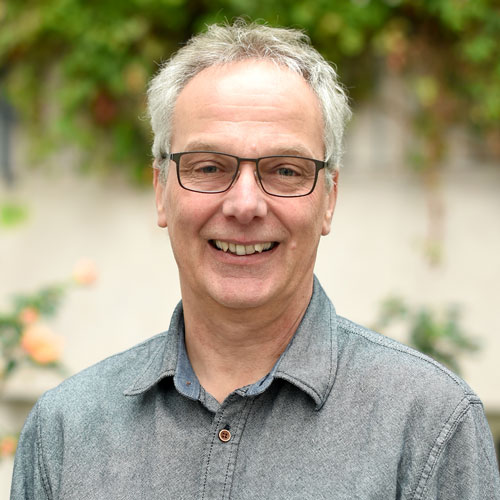
Prof. Dr. Andreas Gattinger is the scientific director of the Gladbacherhof teaching and experimental farm and holds the professorship for organic farming with a focus on sustainable soil use at Justus Liebig University Giessen. In this interview, he explains what activities the university is planning for the Organic Field Days.
Three months to go until the Eco-Field Days at the Gladbacherhof on June 28-30. How do you incorporate current university projects into the three-day event?
Gattinger: Climate is not only a key topic at the Organic Field Days, but also in my area of expertise. We will therefore focus on this and show all current projects on climate effects in animal husbandry and plant cultivation. We will also be looking at the breeding of drought-tolerant varieties, the water issue and nitrate. For example, we want to demonstrate live in two field trials how greenhouse gas emissions are measured in the field and how organic practices can contribute to reducing emissions. It is important to us to present things in such a way that conventional farms can also benefit from these findings. As an example, I would like to mention the EIP project “Economical vegetable production in near-natural mulch systems” (mulch vegetables). The aim of the project is to integrate climate-resilient vegetable cultivation into arable crop rotations in order to offer more variety in regions with a low level of vegetable self-sufficiency.
In addition, other departments and professorships from the University of Giessen’s Faculty 09 of Agricultural Sciences, Ecotrophology and Environmental Management will also be presenting themselves in two tents and in several outdoor activities, highlighting the wide range of study opportunities at the university.
They also show how agroforestry and integrated animal-plant systems contribute to climate protection.
Gattinger: Yes. We are demonstrating our research activities in these areas as well as the resulting diverse opportunities to contribute to climate protection and improving the stability of agricultural systems. Area-based animal husbandry in particular and the clever interlinking of crop cultivation and animal husbandry hold enormous potential in terms of yield stability, risk minimization and resource protection. These topics will not only be covered during the field tours, but also in parallel lectures, workshops and panel discussions.
And start with the major Green Dairy project.
Gattinger: Yes, we are investigating the complex effects of organic high- and low-input milk production on animals, plants and the environment, as well as social acceptance. The core animal experiment takes place in the new research barn for comparative milk production systems. The outer shell of the new barn for two herds of 64 cows each has now been completed. Work on the interior fittings, such as the installation of the group partitions, electricity, water and milking and feeding robotics, is in full swing. In this project, which is funded as part of the Hessian LOEWE excellence program (duration: 2022-2025), we are investigating important questions about the future of livestock farming and the intensity of use of resources in organic agricultural systems. The whole project is divided into 14 project areas and 14 new employees have started their research activities since the beginning of the year.
Planning the Eco-Field Days requires a lot of energy. What are the benefits for the university and for the Hessian State Domain Gladbacherhof?
Gattinger: It really is a major feat: for example, planning the exhibition areas into the stringent crop rotation concept. In addition to the Organic Field Days, as a team we also manage the daily challenges of a research-intensive, but also economically oriented teaching and testing operation.
However, the whole thing also offers a wide range of opportunities. It is important to us at the department and at the University of Giessen to further develop agricultural sciences as a systems science. The Organic Field Days offer an excellent opportunity to demonstrate and discuss this with the two closely interlinked production areas of animal husbandry and plant cultivation at the Gladbacherhof. There is so much innovative power in many measures for climate-friendly and resilient agriculture. In many cases, this power comes from practice and can be further developed together with universities. We want to show that agricultural research and teaching here unites a variety of disciplines and does not follow an ivory tower mentality.
How do the students get involved in the course?
Gattinger: On the one hand, around 100 students will support us on site with the organization, catering and experimentation. On the other hand, student projects and theses will also contribute to the content on the key topic of climate. Students from the “Agroforestry Systems” and “Sustainable Agricultural Systems” modules created posters on relevant topics during the winter semester, which will be exhibited at the Eco-Field Days. Sustainable agricultural systems, including agroforestry, are closely linked to the topic of climate, both because they offer climate-resilient alternatives to traditional agriculture and because they can contribute to reducing emissions. Students are familiarized with this interlinking of agriculture and climate early on in their studies and have the opportunity to pass on their acquired knowledge to interested parties at the Eco-Field Days.
Faculty 09 with Agricultural Sciences, Ecotrophology and Environmental Management also offers a forum. With what content?
Gattinger: We offer a forum with topics such as agriculture in the face of climate change and alternative livestock farming systems. The highly topical and highly controversial subject of wolves will be dealt with in specialist presentations and a panel discussion. For a whole day, the focus will be on regenerative agriculture and agroforestry systems from different perspectives. There will also be a block on sustainable nutrition and future food systems. We need to broaden our perspective from pure agriculture to food systems in order to develop sustainable alternatives for agricultural production.