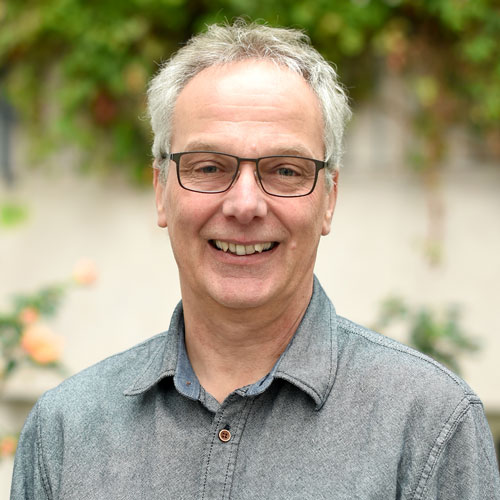
Managing Director FiBL Deutschland e.V. and Head of Circular Animal Husbandry
Why is the focus on animal husbandry at the Öko-Feldtage?
Animal husbandry occupies a special position in organic farming: The use of manure based on animal excretion and thus the preservation of closed nutrient cycles plays a central role. It also increases biodiversity and contributes to a more sustainable ecosystem. Furthermore, the issue of animal welfare and ethical responsibility, which is increasingly in demand by society, has long been present in organic farming.
In addition to the content aspect, the visitor survey from the last Öko-Feldtage showed us that animal husbandry was the third most common reason given for a visit. So far, however, we have only been able to respond to this demand with a small range of exhibitors and innovations. We would like to expand this in the future.
What can visitors expect?
We have a varied program and offerings that take many aspects of animal husbandry into account. For example, there will be a central “animal husbandry meeting point” from which all guided tours on the topic of animals will start. Wassergut Canitz will open its barn and pasture gates to give visitors an insight into a composting barn, forest grazing systems and the grazing of floodplains. There will also be a focus on mobile slaughtering, with various guided tours, exhibitors and lectures. Speaking of lectures: Of course, there will once again be an animal forum with many exciting presentations.
We have also been able to attract new exhibitors in the animal sector to offer visitors an insight into the portfolios of various specialist companies. As a special highlight, the Society for the Preservation of Endangered Domestic Animal Breeds (GEH) will be exhibiting sheep and cattle to provide an insight into the diversity of breeds, which is particularly important for the organic sector.
Animals on the Öko-Feldtage – how is this compatible with animal welfare?
We are aware that the Exhibition Management of animals places special demands on us as organizers. However, it has been shown time and again that the actual contact and experience of the various animals and breeds on site is of great importance for the visitors’ perception. In order to do justice to animal welfare, we have taken many aspects into account: We allow the animals sufficient space and shade as well as a retreat area. We also keep the time the animals spend on site as short as possible; they are the last to arrive and the first to leave. We work closely with the responsible veterinary authority and GEH e.V., as the latter in particular has a great deal of experience with animals at exhibitions. They are also responsible for the care of the animals on site.
How can animal husbandry and water conservation be combined?
There are many ways to combine animal husbandry and water conservation, but they require more planning. If managed correctly, animal husbandry can even contribute to the protection or improvement of water resources.
This begins with housing during the vegetation-free period. This is because year-round grazing, especially in water-sensitive areas, jeopardizes the high quality requirements of the soil. In turn, keeping cattle in stables during the cold season places special demands on the agricultural construction – the keyword being drainage safety. With a good grazing system, for example with rotational grazing, soils can be made more stable and thus erosion protection can be built up. Rotational grazing reduces nutrient inputs from animal excrement and thus protects water quality. In general, fertilization, whether with or without grazing, plays a central role in water conservation. Another means of conserving water resources is the use of rainwater and process water. There are now many intelligent systems that are safe and sustainable.
If you would like to find out more about the topic or even see live how animal husbandry can work in a water protection area, the best time to come is on 18. + June 19 at the Öko-Feldtage.